.png)
She's The First: Girls' Advocacy & Social Media Engagement

A case study of a nonprofit organization for girls' advocacy, social media user engagement, and media practices.

Introduction
How often do you find yourself browsing social media and encounter an ad or a YouTube post about a nonprofit organization? How engaged were you with the video? What emotions did those videos evoke? Were there any videos or content that inspired you to engage more with that nonprofit organization?
A nonprofit girls’ organization was curious about these very questions: what are the most effective media outreach practices and techniques used by other girls’ organizations? Are they successful, and how can they implement them to boost user engagement and retention within their organization?
As a Lead UX researcher at the Games and Interactive Technology Lab at Claremont Graduate University, I, Serena Lao (left image), headed a team of three, including Vivian Wang (middle image) and Jeffrey Phon (right image).
We focused on cross-comparing the media practices of nonprofit organizations that advocate for young girls globally, with a particular emphasis on girls in minority communities and developing countries.
We set out to conduct a comparative analysis to identify and gather the best media practices, trends, and content being used among 9 girls’ nonprofit organizations:
Row 1: Girls Opportunity Alliance, Mona Foundation, Girl Up
Row 2: Girl Effect, Girl Rising, Rise Up
Row 3: Purposeful (We are Purposeful), Global Fund for Children, Malala Fund
Stages
Desk Research
Analyze non-profit social media outreach strategies, content, and user engagement
Best Practice
Identify effective techniques and approaches utilized from organizations
User Interviews
Observe participant reactions and record opinions about popular media strategies and formats
Methodology
Our methodology consists of assessing and comparing the different girls’ organizations. We analyzed what media strategies have been used and deemed successful determined by views, likes, saves, and positive comments.
We first began with conducting desk research, then user interviews later.
Desk Research
Using traditional UX research methods such as Competitor Analysis or Feature Analysis Matrix to compare these organizations wasn't logical because, frankly, they aren't competitors. Therefore, my team and I decided to conduct a comparative analysis and create a feature matrix that illustrates the strategies employed by these organizations and compares them instead.

Desk Research Themes
We utilized 5 themes to compare the nine organizations and assess which methods are effective and which content is receiving less user engagement:
Types of Social Media Used
Types of Content Uploaded
Engagement level (viewer’s count, comments, likes, and sharing)
Common theses and topics
Use graphics, captions, subtitles, hashtags, sponsored content, and branding elements, and storytelling approach
User Interview
The next stage of our project involved conducting a mix of user interviews and usability testing on three videos selected from the different girls’ organizations. These videos were selected based on their views and engagement, as well as the content they were specially displaying. Our sample size included 11 participants.
This methodology was to gain an insight into what the general public thinks when they encounter such media content on their feed and what sort of content would increase their likelihood to engage with the video. The sample representative ranged from no previous experience with engaging in activism and nonprofits to highly interested in activism and donated to nonprofits.
Thematic analysis was used to identify common themes that arose from the user interviews on what sort of content would engage the participants in our sample.

User Interview Findings
We discovered that the general public, when it came to the media that is shown by the three different girls’ company, their reaction to the media contents varies. For those who are interested in the content, and wish to learn more about the organization, whether that is through the content that is being shown or the stories that are being told. Those who are not as interested in activism or non-profit organizations or do not regularly engage in non-profit organization content wished to see more engaging and informational content, as well as important impact that the organizations had made to engage them further.
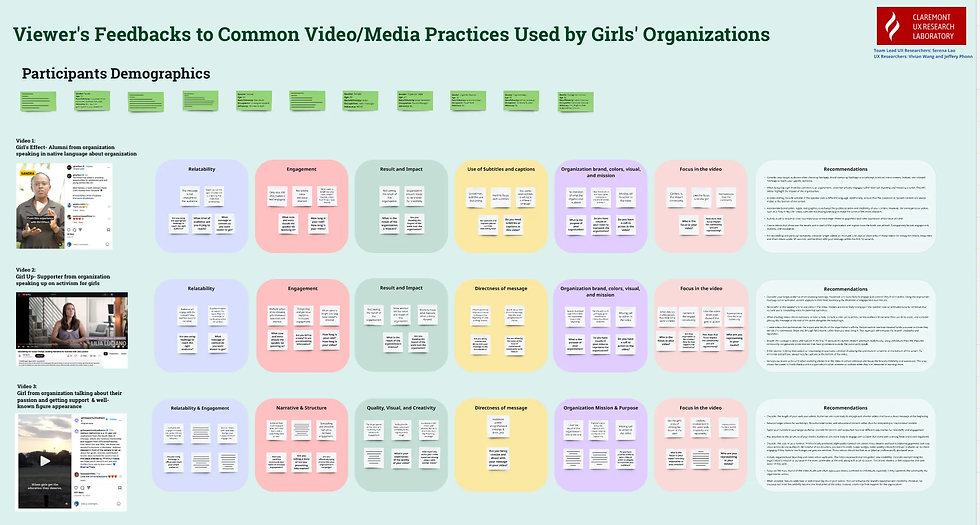
From the participants’ reactions and feedback to the three videos that we showed them, these were the major themes that we found:
Reliability | Organization brand, colors, visuals, and mission values |
Engagement | Directness of Message |
Result & Impact | Focus of Video |
Use of Subtitles & Captions | Narrative & Structure (Storytelling) |
Quality, Visual, Creativity |
We also brainstormed questions and recommendations based on the observations we noticed under the identified themes. We suggest that the organization’s media team consider these when evaluating each theme considering what their media content should consist of to engage the general audience.
4 Sample Questions from Themes
Focus On Video
Are you showing the impact of the work from the organization?
Organization’s Brand, Colors, Visuals, & Mission Values
Do you include clear and impactful visuals that represents your organization throughout the video?
Directness of Message
Are you allowing the voice of the local or represented community to be heard?
Engagement
What tone and voice should the speaker be speaking with and in?
7 Recommendations for NPO's
Consider your target audience when choosing hashtags.
Avoid overusing hashtags in an attempt to attract more viewers; instead, use relevant hashtags to reach your specific audience.
Show girls being actively engaged in a community.
Avoid having the girls standing and following a script. This will better highlight the impact of the organization.
Include subtitles in video editing.
Ensure that the questions or spoken content are always visible at the bottom of the screen.
Incorporate brand colors, logos, and graphics.
This enhances the professionalism and credibility of your content.
For more personal videos, such as a "Day in My Life" video, consider minimizing branding to make the content feel more relatable.
Include a Call-to-Action (CTA)
This encourages viewer engagement and raise awareness of the issue at hand.
Create videos that impact
Showcase results of the organization and explain how the funds are utilized. Transparency boosts engagement, likability, and reputation.
Consider longer videos on YouTube
For storytelling and narratives, use clips or short edits of these videos for Instagram Shorts.
Keep reels and short videos under 30 seconds, and be direct with your message within the first 10 seconds.


Comments