.png)
Are Millennials & Gen Z Ready to Prioritize Their Legacy?


End-of-life planning is often associated with older adults, accumulated wealth, and formal legal processes. For Millennials and Gen Z, the topic is rarely top of mind. As younger generations begin to acquire assets and manage increasingly digital lives, we explored whether legacy planning feels relevant to them at this stage of life.
Our team partnered with an early-stage startup exploring modern approaches to end-of-life planning. The goal was to explore how younger users perceive digital-first, incremental approaches to end-of-life planning, particularly those emphasizing peace of mind over formal legal documentation.
Team
Mark Reid (Team Lead), Megan Kight (UX Researcher), Rosy Darla (UX Researcher)
Gauri Parnaik (UX Research Assistant), Sean Peterson (UX Research Assistant)
Methodology
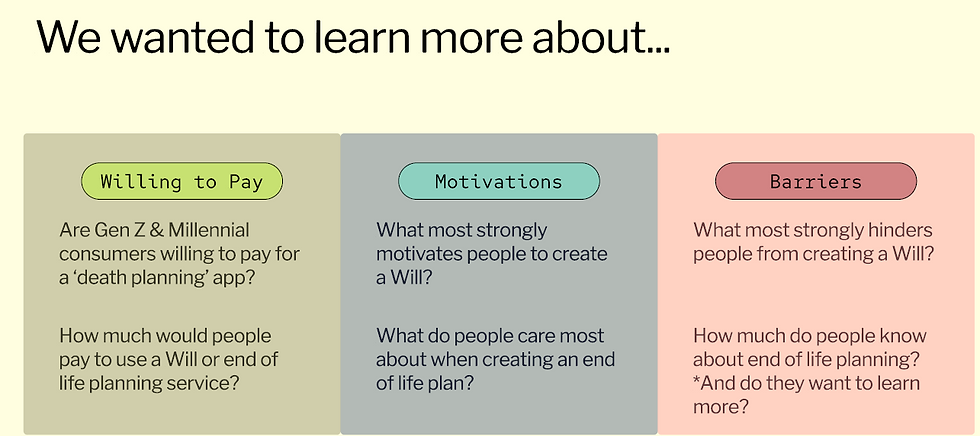
We began with the assumption that people are more likely to engage in end-of-life planning when they understand its benefits and see it as personally relevant. Our research questions were designed to explore awareness, behavior, and the internal thought processes participants experience when considering death, responsibility, and ownership.
We used a mixed-methods approach that included an online survey and semi-structured interviews. Due to the sensitive nature of the topic and the absence of a recruiting budget, we relied on convenience sampling through researchers’ extended networks. While this approach limited generalizability, it supported more open discussion around a topic many participants described as uncomfortable or easy to avoid.
Execution
Survey
The survey included fourteen structured and open-ended questions. It was distributed through social media, email, text messages, and other online channels.
A total of thirty-one participants completed the survey (n = 31). Six participants reported having an existing will, while twenty-five did not.
Interviews
Seven follow-up interviews were conducted via Zoom, each lasting between twenty and thirty minutes.
Two interview participants had a will, and five did not.
Interviews combined structured and semi-structured questions to explore attitudes, discomfort, and perceived relevance of end-of-life planning concepts.

Key Findings
Factors Influencing Will Creation
Our research revealed that 32% of participants did not prioritize creating a will, while 29% lacked knowledge on the subject. 24% expressed concerns about the potential cost, 10% cited time constraints, and 2% had previously attempted to create a will but lost interest or felt uncomfortable with the process.

A recurring theme was the perception that wills were not relevant to participants’ current life circumstances.
Despite these barriers, more than half of participants expressed some interest in documenting their wishes in the event of their death. This suggests curiosity may exist even in the absence of urgency.
Motivators
One of the most common motivations for creating a will was the desire to pass on meaningful or valuable possessions. Participants who felt they lacked financial assets often dismissed wills altogether, equating “having a legacy” with monetary value alone.
This narrow definition of value excluded sentimental, digital, and symbolic possessions, which were rarely considered assets worth planning for.

Recommendations
The findings suggest several areas for further exploration, including how demographic factors relate to interest in end-of-life planning.
Some future questions to consider:
Is there a correlation between economic class, education, and age? | What are some of the specific questions that can spark interest if the interest does not currently exist? |
Is there a drastic difference between Gen Z and Millennials? | Does their asset acquisition have a significant impact on their need for the service? |
For this sample group, burials and the procedures their bodies will undergo after death do not seem to be a major concern. We recommend using a larger and more diverse sample to determine if this trend remains consistent. Conducting a qualitative analysis of motivations specific to body disposition could be advantageous.

Now that I’m dead, how do I get rid of all my stuff?
This research helped stakeholders better understand why traditional end-of-life planning tools struggle to resonate with younger generations.
In this study, traditional wills were rarely perceived as an immediate priority among participants. However, that does not mean legacy planning lacks relevance. Interest appears to depend heavily on framing, perceived value, and emotional accessibility.
If the process can feel less intimidating and more aligned with how younger users define ownership and responsibility, engagement may increase over time.
In many cases, the challenge is not creating interest, but helping people recognize that the questions already matter to them.

Note: Certain details have been intentionally generalized, altered, or omitted to respect the confidentiality of our early-stage partner.


Comments